Sunday, June 14, 2015

Rain Rain Go Away

One of our first posts was about the rain in Ghana. Here we go again.

We drove to church in the rain today. It has been raining off and on for a couple of weeks.
These are members of our ward walking home from church. The reason they are not in our car is because we had nine passengers in our seven passenger car including two babies and the oldest man in the ward.

This is the road we drove through going to and from church. We drive a kilometer or two on road like this. 

The members walk to church in this. Despite the mud the spirit is strong once we arrive. 

When the path is not clear you have to make do.

Nevertheless, the inconvenience of walking to church in the rain and in the mud is far outweighed by what the weather has done to other Ghanaians. A week and a half ago it rained four inches in one day and flooded significant parts of Accra. Depending on which news report you believe between 150 and 250 people lost their lives as a result of the weather.

Compare this boy's plight to that of our neighbor, above. 
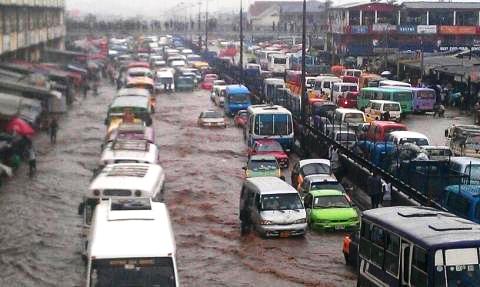
The streets were flooded.

The parking was flooded.

The drainage system was flooded.

Some of the senior missionaries' cars were flooded.


Some of the senior missionaries' apartments were flooded. After the Heckels ground floor apartment was flooded they were moved to an apartment at the temple complex on the second floor where a pipe burst and flooded them again. Then they moved up to the third floor.

We are only at the beginning of the rainy season. Hopefully we will not experience further damage.


Dakar

The northern most country in the Africa West Area is Senegal. Senegal is 90% Muslim but prides itself on tolerance and hospitality. Recently we went to visit the saints in Dakar, the capital of Senegal.

Dakar has the style and feel of a Saharan City. It has 1.9 million residents.

It is also the most westerly point in Africa.


"The saints" in Dakar consist of a family whose father is assigned to the U.S. Embassy, the Petersons, six native Africans, none of whom is native Senegalese, and one Chinese expatriate. They form a Group and meet in the family's home.

The Senegalese pride themselves on being physically fit. 
They are regularly seen running on the street or the beach and wrestling.

In front of the high rise hotels these Senegalese are using their beach.

Not all beach front residences are high rises.

Senegal was a French colony and French cuisine lingers, gratefully. 
These are the best pastries we have had in Africa.

The restaurant where we had dinner is reminiscent of Mediterranean Italy.

Dakar's most prominent landmark is this statue of a father, mother, and child escaping slavery, a gift to the Senegalese from the people of North Korea.

Senegal has a stable government. We felt safe the whole time we were there.

In the bay of Dakar is Goree Island which was used hundreds of years ago to hold slaves before they were shipped from Africa.

The architecture gives you get the feeling that Goree could have been used as the model for Adventureland.


You could spend the whole day taking pictures on Goree.

Artisans on Goree are famous for their sand paintings.

There are also merchants anxious to sell you their wares. These three women followed Sister Wilde for half of our excursion to Goree.


There are artisans on the mainland as well. The craftsmen in this shop paint on the back of glass.

We loved Dakar and hope to see the Church formally recognized there soon.

Wednesday, May 20, 2015

Creating New Stakes, Wards and Branches

 One of the most fun things we get to see is the growth of the Church in West Africa. One of our jobs is to process the paper work to create the new stakes, wards and branches.Displaying FullSizeRender.jpg

The strong faith and love that the people have here for the gospel is powerful. The Church has only officially been in West Africa about 40 years since Nov. 1978 and so we are seeing its very beginning, its birth.  Bob and I have been attending wards in the Ashiman Stake for the last few months - Bethlehem, Kpone, Dawenya and Michel Camp Branch.


In 2005 Ashaiman was one ward. They met in a tent which had to be put up and taken down each week. When it rained, the woman and children would move to the inside of the tent, the the men would line the outside. 


In 2008 they got a building to hold church in, It quickly became the Tema Stake

But the people kept coming. The Tema Stake divided  in 2014 and the Ashaiman Stake was created . Now we have two Stakes.
All this from one little ward holding church in a tent. .


This is the first Stake Conference of the Ashaiman Stake. If you look closely you can see Elder Wilde and me and Doug and Becky Stoker.  It is such a blessing to be among these people. Elder Holland said it well when he said, "Africa is one of those special places where you get to see the glory of the Lord, the wonder and the miracle of the Restoration, quite literally unfold before your eyes."

Tuesday, May 19, 2015

Windows of Light

One of the blessings of our mission is the temple in our back yard.
At night it glows.


 "And I will also be your light in the wilderness; and I will prepare the way before you...."
(I Nephi 17:13)


 "I will set my sanctuary in the midst of them for evermore." (Exekiel 37:26)


"Come and be baptized unto repentance, that ye also may be partakers of the fruit of the tree of life."
(Alma 5:62)


 "Wherefore he saith, Awake thou that sleepest, and arise from the dead, and Christ shall give thee light." (Ephesians 5:14)
One day when I was little and staring at the temple, I asked my Dad, "Why is the angel blowing his trumpet?" He said, "He is saying "Good News the Church is restored."
Good News!


Sunday, May 17, 2015

James Town

James Town is the oldest neighborhood in Accra and has more personality than almost anywhere else in town. 


A highlight is the 30 meter red and white colonial lighthouse. You can climb the spiral staircase and see much of the city.


James Town is also the home of James Fort Prison, now closed. It's empty shell is a reminder of hard times past.


With our guide, "Nice One," we went down into the fishing village below the lighthouse. 

This is the 3rd largest harbor in Ghana next to Tema and Cape Coast. Fishing is still the traditional way of life here and fishing boats come in early to mid morning with their catch.


                                                     Boats are made in the village.

Fish are carried to the shore and laid out to dry or put in barrels and taken to market.


The ground is covered with sardines drying so they can be sold. 
Some of the fish are put into trays to smoke them.
Repairing the nets are one of the major jobs that need to be done and redone.

The life of a fisherman's family is not easy.


The work is hard.

But despite this, the people had a sense of community here and they let everyone come here. The school is also paid for by the community so all of the children can go.
This is Elder Wilde in front of the school. This was Saturday so it was closed.

                                    There is a sense of belonging here. And fishing is very important.

The children grow up with boating dreams.