Wednesday, July 9, 2014

In Search of the Perfect Wood Carver

A week ago Saturday we went to Aburi. Like many of our trips the point of this journey was to find the ever elusive perfect wood carver. Since we all have to take home the perfect memento we all look for the most skilled wood carver to create it for us. Each couple has their favorite. The preferred wood carver has shifted from Wisdom (yes that is his name) to Sam to Richard to Able, who resides in Aburi. Accordingly, the trip was worth it no matter how long or how far.


The wood carvers' craft.

Living in Accra you get the feeling that all of Ghana is flat. Aburi is about 55 kilometers from Accra and is in the mountains. On the way we encountered fog, a climatic condition I didn’t think existed here. There were multiple side of the road fruit stands. It kind of reminds you of driving up U.S. 89 in Davis and Weber Counties into Box Elder County in the fall in Utah except the pineapples, mangos, papayas and the bananas are better here. In any event we arrived at Aburi and found it to be the home of the actual wood carvers.


Actual wood carvers in Aburi, Ghana.

In the other markets you get the impression that the people you are dealing with are the middle men, used car salesmen who are between jobs, and that the actual wood carvers are in the back someplace, maybe as far in the back as China, but you never believe you see an actual person who cares wood. For all we know it could all have been imported from Camp Steiner in the Utah mountains. In Aburi you get to see people actually carving wood. While there are naturally some other shops selling clothes and trinkets most of the shops feature carved wood.


Checking out the merchandise.

In “the pit” and the Makola market there is some minimal sense of order in that there are paths between the shops but no uniformity otherwise. In Aburi the city fathers obviously had a plan. Each shop keeper has a section in the concrete buildings which gives the place a certain amount of order.


Shops at Aburi.

As with all the other places the owners are willing to make a deal with you, “how much you want to pay” is the reply after you say “too much.” After the opening bid from one of the shop keepers I borrowed a line from my father-in-law “you must be the richest man in the whole market” which brought a broad knowing smile from the shop keeper and a certain bond between the negotiators. We did have to buy some trinkets to make the trip worthwhile but so far we have not found the perfect wood carver. We know he is out there. We will keep searching until we find him even if we have to extend our mission to do it.


Closing the deal.


The shop keeper's daughter.


The finished product.


The real workshop at Aburi.

Sunday, June 29, 2014

Going to Church in Ghana


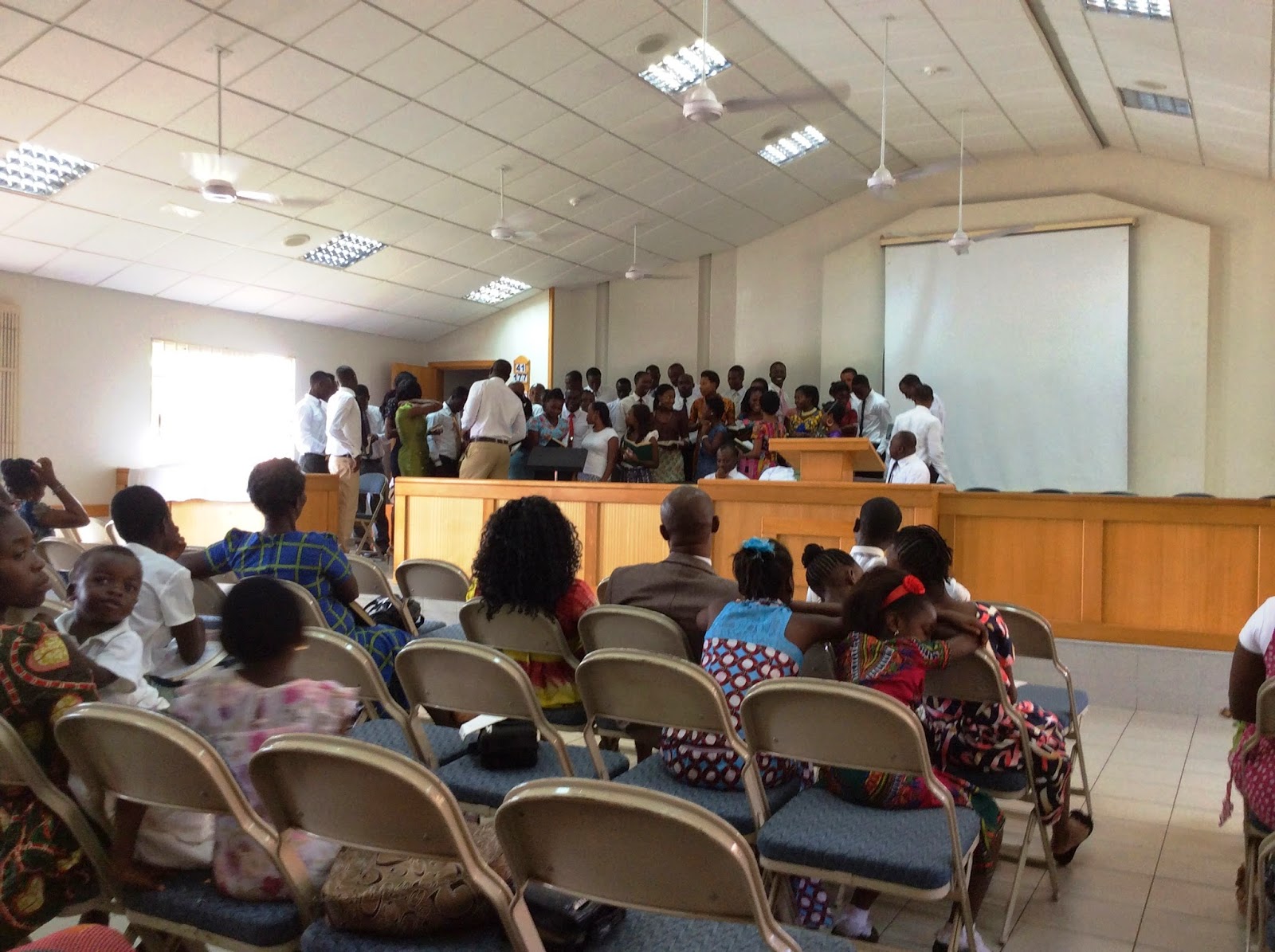
People say that the Church is the same in Salt Lake City as it is in Paris, or Rome, or Spanish Fork. It is, and it isn’t. We have been working with the members of the Madina 1st and 2nd Ward of the Adenta Stake helping with the temple preparation classes to get folks to the temple for their own endowments. As a result we attended two sacrament meetings, two Sunday school classes, and one priesthood / relief society meeting each week for the last six weeks. We meet in the stake center which is a fairly new building. It has air conditioning in the bishops’ and presumably the stake president’s offices. In the chapel and the cultural hall it has about two dozen ceiling fans which do a reasonably good job of making the building habitable on Sunday morning when the windows are opened. The classrooms are also “air conditioned” with open windows, ceiling fans, and another window above the blackboard and the door which opens into the hallway even when the door is closed. I didn’t see any similar construction in my ward in Salt Lake.

In Rome I did see people leave the windows open, briefly. Then a breeze came up and we had to close them


The announcements are different too. Today the bishop announced an event to occur in seven days and described it as “today Saturday” which clearly distinguishes it from two or three Saturdays from now. I love this same bishop’s announcements on starting times for events. “The young single adult activity will be Saturday at 10:00, that’s 10:00, 10:00. It is not 10:10 but 10:00.” As a former bishop who started many an early morning sacrament meeting at 9:00 with one fourth of the ultimate congregation present I can relate completely to his frustration and I love his method of dealing with it.

The bishop and all the speakers begin with “good morning brothers and sisters.” To which the congregation responds “good morning.” Kind of like going to church in Hawaii without the lei. Our speakers have the good taste not to say “I can’t hear you, lets try that again.”

The brethren all have one hand behind their back as they pass the sacrament. On the sacrament table is the two liter bottle of pure water they poured the sacrament water from.

The halls of the Ghanan building a just like those in Salt Lake, Spanish Fork and in Rome. They are crowded with Saints who are so busy talking with their friends they haven’t seen since last Sunday that Sunday School and Relief Society / Priesthood meeting start late because the teachers can’t get through the crowd and there is no one in the class room to teach anyway. They are all in the hall.


Ghana and Utah have both suffered the impact of being away from the center of the King’s English. We all know that that stream which runs out of the mountains in Utah is a crick, that we go to the Spanish Fork art museum to see a pitcher and that we are really going fishing on the Sourh Fark of the Provo River. For instance in Ghana this morning we sang Faader in Heaven We Do Believe” but we sang it on key and with vigor. Ghanans Sunday School has one leg up on Utah though. Ghana has Twii (pronounced tree) and Ashanti which are tribal languages. At least half the testimonies in sacrament meeting are in Twii as are some of the answers to teachers’ questions in Sunday School. Today in one of our classes the wife of one of the bishopric member’s stood up half way through the class and used the chart of the plan of salvation on the black board with her explanation to the Twii speaking sisters of what they needed to know before they go to the temple. Twii is one of the options on the head phones in the Accra temple. The bishop in the other ward listened to the answer to one of his questions from a class member and then said “for those of you who don’t speak Ashanti brother so and so said . . .”


Our singing was led by Brother Ansah who was called out of the congregation to lead during the opening announcements. Similarly, we have had our rest hymn sung by the young men and by the young single adult choirs which were called from the congregation after the first two speakers and who performed wonderfully, a cappella.

Notwithstanding any differences described, the sacrament meeting talks were on chastity, family history, and prayer. The priesthood discussion was on President Monson’s talk from last October’ conference, “I will not fail thee, nor forsake thee.” As we left the bishop was interviewing some of the 15 members scheduled to take out their endowments in July. A new member was confirmed in sacrament meeting today and four were confirmed last week.


The Church is the same in Ghana as it is in Paris, Rome or Spanish Fork but it is also different, and in many ways, better.

Monday, June 23, 2014

The colors of Africa

Something that is special about Ghana is the wonderful fabric you can find here.


I love the batiks. Batiking is labor intensive, but produces uniquely colored fabrics and designs. I went with some of the senior missionaries yesterday to Esther’s house to make batik fabric in the back of her home. We were given white material and then we picked out stamps that had been carved in foam. They have an amazing wall of designs from adinkra symbols to zebra, giraffes, and monkeys.


It is an amazing process. First you dip your foam in wax – and then stamp each design. You create your own design and pick your colors.


Then the material is put into pots of dye with your first color and dyed. Then it is laid out on the grass and dried. You then can add more wax and dip it into your second color. You could even add more colors if you had more time.


You never really know what color your cloth will turn. It is kind of like life. The Lord asks you to do different callings in different and colorful places. You keep adding experiences and dipping yourself into them, and you become a different person because of it, more colorful, with more texture and richer.


These are our finished cloths. We are a pretty colorful group.

Sunday, June 15, 2014

A trip to Ada

Yesterday we went with President Reid Robison, president of the Ghana MTC, to visit a village on an island in the Volta River which has a new age solution to an old age problem - light. The island is across the river from the town of Ada. There is no electrical power to the island. Some folks from Provo hired engineers to create a generator used to create power to be stored in batteries which can then be taken home and used to power lanterns so the school children will be able to study at night. The kicker here is that the electricity is generated by school playground equipment powered by the children. One piece was a wheel you push and ride in circles, a whirligig. Another was a swing, another was a glider. They generate electricity which is transferred to the utility building adjacent to the playground and stored in batteries. They also have photo cell panels on the roofs of some of the buildings. That is what we went to see. It was worth the trip for the opportunity to ride a boat across an African river to a village inhabited by real people in a real actual living situation.

We walked down a path with the engineer who installed the generator and went to a couple of villages which are occupied today. The homes were with thatched roofs, some with concrete and block walls and some with mud walls. We met a Canadian student on a break from school for about three months who was living in one of the villages with a sponsor family. She invited us into the buildings the family occupies, a kitchen, a living room building, and a bedroom building. No amenities there. It had a dirt floor which she had covered with wall paper, a mattress with no springs and a mosquito net. The kitchen had a small ember fire burning in a fireplace made from a rock with a pantry tightly sealed with screen. It looked like the place the Disney folks used as the basis for some of their African villages in their theme parks, but it was real.

The families apparently live off of what they can grow and their fishing and oyster business. The ground was littered with, almost carpeted with oyster shells. On the mainland from where we caught the boat there were huge stacks, probably four feet high, of oyster shells and large mats with drying oysters on it. People gathered around shucking the oysters in groups.

Another treat, as we arrived there was a siren blaring and a group of people at the end of the street. As they got closer it was a funeral procession. The casket was being carried by six men with women dancing and singing in the front. Behind the casket was a brass band with several drums. The siren was from the town ambulance which was behind the procession. We understand that funerals are major events and last up to three days.

All in all, it was a wonderful experience even it was four hours of driving on pocked roads with heavy traffic. Deanne got to dance with the children. We marked it on the map so we can go back and see it again however we doubt any second trip would include the funeral or the invitation to see the inside of the home.

Tuesday, June 10, 2014

Chips

We bought a back of Cheetos. We had been warned that the food here might be stale. It wasn't. It did cost $8.00 which is 24 CD. It is amazing how long Cheetos last when you don't have grandkids helping you eat them. Isn't that right Ben? Love you. Wish you were here helping us eat our Cheetos.

Saturday, June 7, 2014

Have Miracles Ceased?

Friday – Got my first 3 mosquito bites at the Christianborg Stake center during President and Sister Judd’s farewell. He has served for three years in one of the Accra Missions. The choir was wonderful. There were two cute girls singing on the front row. They were sharing music from their hearts. Pres. Judd spoke of a man who was raised in Accra. Every time his family walked by the temple his mother and father told him it was cursed and if he looked at it, he would be cursed too. He never turned his head and never looked at the temple. His father died not too long ago and a few weeks after his death his father appeared to him in a dream. He said, “Son, I taught you a lie. I told you to turn your head and not look back at that temple or you would be cursed. That place is not cursed and I want you to go there and get baptized for me.” Being an obedient son, he went to the temple, walked in the front door, and asked to be baptized for his father. They asked him for his paperwork but he said he didn’t have any. They asked for his recommend and he asked “what is a recommend?“ Then they asked him if he was a member and he said no, he just wanted to be baptized for his father. Missionaries were called and they taught him the discussions. He was baptized shortly after and then was allowed to do the baptism for his father. I have wondered why Africans seem to have a lot of very spiritual experiences . Have miracles ceased? No. Just come to Ghana and you will see the Hand of the Lord. This is a land of dreams and visions. I think it is because they are more open to believing their dreams. They do not doubt them and they don’t intellectualize them away. They are a profoundly believing people. Since they will listen, God talks to them. People of faith have miracles.

Getting a drink.

Like most other developing countries, most of the water in Ghana is not drinkable. (That is potable in snooty parlance.) On our trip to Israel we bought our bottled water from the tour bus drivers. I always wondered that it cost two dollars when we bought it from the bus drivers in Israel but only one when we bought it from the driver in Jordan. Here we have it supplied by the Church. When we were in temporary housing we had a giant bottle and a water dispenser in our room. After the Fitzgerald’s left and we moved to our permanent abode the water system was more advanced. It was “triple filtered” so we can get our drinking water from a little tap in the sink next to the larger one from which we get the dish washing water. We have now been here for most of a month enjoying the safety and peace of mind which comes with triple filtered water.